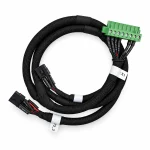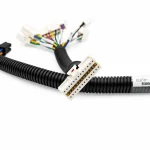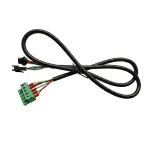
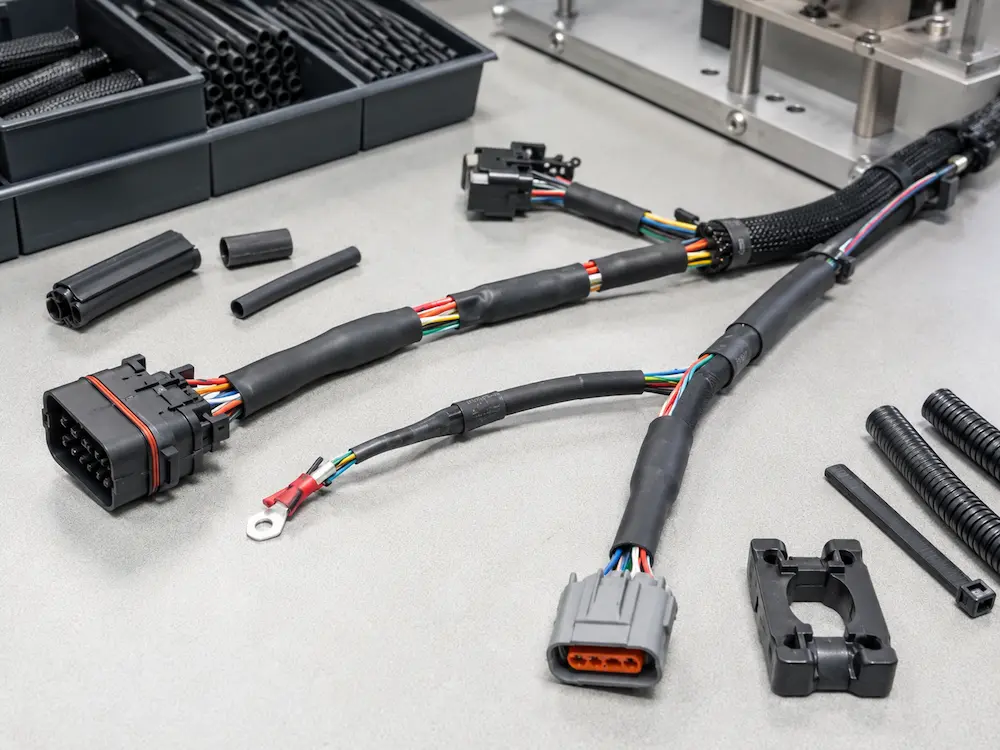
Heat shrink tubing for wire harnesses is a protective tube that shrinks around wires, branches, terminals, splices, or connector exits when heat is applied. It is used to improve local protection, insulation support, strain relief, branch transition control, identification, and sealing support in specific sections of a harness.
Heat shrink is useful, but it is not magic tape with a heat gun. It solves local protection problems very well, yet it cannot fix poor routing, wrong connector positioning, weak strain relief, or an underprotected harness path.
Key Takeaways
- Heat shrink tubing is best used for specific stress points, not as a universal full-harness protection method.
- It can support strain relief near connector exits, splices, branches, and transition areas.
- Heat shrink may reduce flexibility if used too long or placed across moving bend areas.
- Environmental protection depends on the full design, including connectors, seals, routing, and sleeving.
- Choose heat shrink when local control is needed; choose sleeving or tubing when long-route protection is required.
When Does Heat Shrink Tubing Help a Wire Harness?
Heat shrink tubing helps when the harness needs tight local coverage, cleaner transitions, limited strain relief, wire grouping, branch stabilization, identification, or added protection around splices and connector exits. It is most useful where the harness changes structure or where stress may concentrate.
For OEM buyers, heat shrink should be specified by location and purpose. A note that says “add heat shrink” is too vague. The supplier should know where to place it, how much coverage is needed, what it protects, and whether the finished section still bends correctly.
Heat shrink selection should connect with wire harness sleeving options. Heat shrink protects specific sections; sleeving and tubing protect longer routes. Mixing both correctly usually works better than overusing one material and hoping physics behaves politely.
Where Should Heat Shrink Be Used on a Wire Harness?
Heat shrink should be used where local control is more important than full-length flexibility. Typical positions include connector exits, branch transitions, splices, soldered areas, terminal protection zones, cable identification areas, and places where a sleeve or tape needs a stable ending point.
| Heat Shrink Location | Why It Is Used | Risk If Misused |
|---|---|---|
| Connector exit | Supports the cable exit and creates a cleaner transition from connector to harness. | If too stiff or too close to a bend, it may transfer stress to the terminal area. |
| Branch transition | Helps organize wires where one harness splits into multiple branches. | If positioned badly, it can restrict branch movement or create a hard bend point. |
| Splice or joint area | Adds local insulation support and helps keep the joint area controlled. | If the joint design is poor, tubing alone cannot make it reliable. |
| Sleeving end point | Locks or finishes the end of braided sleeve, tape, or protective covering. | If placed in a moving zone, the stiff transition may become a stress point. |
| Identification section | Can carry printed marking, color coding, or part identification in selected areas. | If hidden after installation, the identification value is lost. |
Use this table to mark heat shrink positions on the drawing. If the position is not controlled, production workers may apply it differently from sample to sample.
If X → Choose Y: Heat Shrink Decision Logic
Choose heat shrink tubing when the issue is local protection, transition control, or strain relief support. Choose sleeving, corrugated tube, tape, routing change, or connector redesign when the issue affects the full harness route, repeated movement, heavy abrasion, or environmental exposure.
| If Your Harness Needs… | Choose This Solution | Reason | Related Guide |
|---|---|---|---|
| Local support near connector exits | Heat shrink tubing with connector position review | It stabilizes the exit area without covering the entire harness. | Connector positioning |
| Long flexible route protection | Braided sleeve or harness tape | These options are usually more suitable for flexible routing sections. | Wire harness sleeving options |
| Exposed abrasion or rough handling | Corrugated tube or stronger mechanical covering | Heat shrink may not provide enough coverage for long exposed routes. | Outdoor wire harness protection |
| Repeated flexing near a moving joint | Bend review with flexible protection and strain relief | A stiff heat shrink section can create a stress point if placed badly. | Wire harness bend radius |
| High-temperature operating areas | Material and routing review before heat shrink selection | The tubing material must match the temperature exposure and installation condition. | High-temperature wire harness design |
This table helps buyers avoid asking heat shrink to do every job. Heat shrink is excellent for local control, but it should not become the default answer to every protection question.
When Is Heat Shrink Tubing Not Enough?
Heat shrink tubing is not enough when the harness faces long-route abrasion, uncontrolled movement, tight repeated bending, major mechanical impact, poor connector sealing, or harsh exposure that requires a complete protection strategy. It improves local sections, but it cannot rescue a weak harness design by itself.
- Long exposed harness routes
- Use sleeving, corrugated tube, tape, or route changes instead of relying only on short heat shrink sections.
- Repeated flexing areas
- A stiff heat shrink section may create a stress transition if placed where the harness moves frequently.
- Poor connector sealing
- Heat shrink around the cable exit cannot fully compensate for the wrong connector, missing seal, or unsuitable mating interface.
- Sharp edge contact
- Heat shrink may add surface protection but does not replace proper routing, edge protection, or mechanical shielding.
- Unclear production instructions
- If length, position, and coverage are not defined, different workers may apply heat shrink inconsistently.
Practical Heat Shrink Checklist for OEM Buyers
A practical heat shrink checklist should define where tubing is used, why it is used, how much coverage is required, and whether the finished section still fits the routing path. Heat shrink should be controlled like a design feature, not treated as a last-minute workshop habit.
- Confirm the exact heat shrink locations on the harness drawing.
- Confirm whether the purpose is protection, insulation support, strain relief, identification, or finishing.
- Confirm whether the selected tubing affects bend radius or branch flexibility.
- Confirm whether heat shrink is placed too close to connector latches or service areas.
- Confirm whether printed markings or color coding remain visible after installation.
- Confirm whether heat shrink is compatible with the selected sleeving or tape.
- Confirm whether sample and bulk production use the same tubing length and position.
- Confirm whether any heat shrink change requires drawing or BOM revision control.
Recommendation for Heat Shrink Use in Custom Harnesses
For custom wire harnesses, use heat shrink tubing where the design needs local control. Do not use it as a shortcut for poor routing, weak strain relief, unsuitable connectors, or missing sleeving. The safest approach is to define heat shrink by position, function, and inspection requirement.
Lex can review connector exits, branch transitions, sleeve endings, and stress points before recommending heat shrink placement. If the harness is used outdoors, near heat, or in moving equipment, combine heat shrink selection with outdoor protection and bend review before approving the sample.
FAQ About Heat Shrink Tubing for Wire Harnesses
What is heat shrink tubing used for in wire harnesses?
Heat shrink tubing is used for local protection, insulation support, strain relief, branch transition control, identification, and finishing around selected wire harness sections such as connector exits, splices, branches, and sleeve endings.
Can heat shrink tubing protect an entire wire harness?
Heat shrink tubing can cover selected sections, but it is usually not the best full-length protection method for flexible or moving harness routes. Sleeving, tape, corrugated tube, routing changes, or combined protection may be better depending on the application.
When should heat shrink tubing not be used?
Heat shrink tubing should not be used as the only solution for long-route abrasion, repeated flexing, poor connector sealing, sharp edge contact, or unclear routing problems. It supports local protection but cannot replace a complete harness protection design.
What should buyers confirm before approving heat shrink on a harness?
Buyers should confirm heat shrink location, purpose, length, material suitability, label visibility, bend impact, production consistency, and whether the finished section still fits the actual routing path inside the equipment.